Solutions
Fill-level sensors and connectivity
Radar measurement, an eight-year battery, and a mobile network that already covers the country. The unglamorous half of the system, and the half that decides whether anyone trusts the other half.
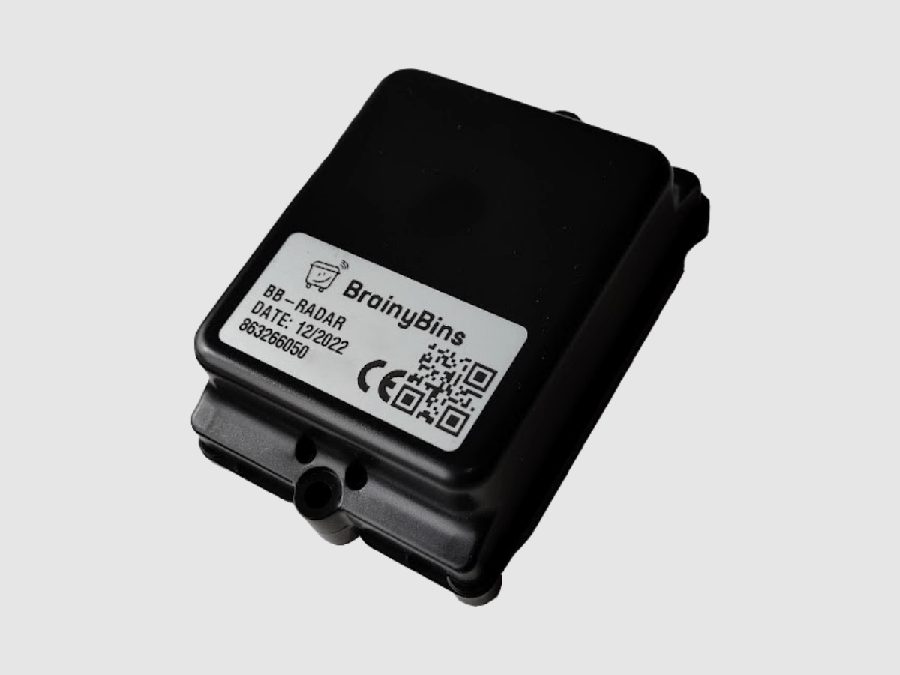
A bin fill-level sensor is a sealed, battery-powered device fitted inside the lid or top of a waste container, and it is what makes sensor-led waste collection possible. It measures the distance down to the surface of the waste using radar, converts that to a percentage of capacity, and transmits the reading over the NB-IoT mobile network several times a day.
No wiring, no mains power, no modification to the container. Around ten minutes to fit and register. Battery life of roughly eight years at six readings a day.
Why radar rather than ultrasonic
This is the single most consequential specification decision in a smart waste project, and it is the one most often got wrong.
Ultrasonic sensors work by timing a sound pulse. They are cheap and they are fine against a flat, hard, reflective surface. Waste is none of those things. Flattened cardboard absorbs and scatters sound. Paper does the same. Film plastic flutters. A carrier bag hanging near the sensor returns a strong echo from nothing. The result is a stream of readings that look plausible and are wrong, and once a supervisor has been sent to two empty bins flagged as full, the system is finished politically whatever the dashboard says afterwards.
Radar measures with millimetre-wave reflection instead. It is materially more tolerant of irregular, absorbent and light surfaces, which is precisely the profile of recycling waste. Vejle Municipality's original 2021 trial — using non-radar sensors — produced error reports on up to 30% of readings. The authority changed supplier specifically to obtain radar measurement, and now reports very few faults, describing performance as clearly better than the target set for the test period.
Sensor specification at a glance
- Measurement
- Millimetre-wave radar fill level
- Also reports
- Temperature, GPS position, tilt, battery state, fault status
- Mounting
- Inside the container lid or upper shell; no wiring or drilling of the shell
- Install time
- About 10 minutes including software registration
- Battery life
- Around 8 years at 6 readings per day
- Reporting rate
- Typically 6 per day; up to 60 per day supported
- Connectivity
- NB-IoT over existing UK mobile networks
- Enclosure
- Sealed, lightweight, shock-resistant
- End of life
- Components can be dismantled and recycled
- Suits
- Street bins, semi-buried and underground containers, bring sites, communal and trade bins
Connectivity
NB-IoT: why the signal reaches a buried container
NB-IoT — Narrowband Internet of Things — is a low-power mobile standard carried on the existing UK cellular network. You do not build anything, install any gateways, or maintain any infrastructure. Each sensor carries its own SIM, included in the subscription.
It matters for three practical reasons. It reaches places ordinary mobile signal does not, including below ground level inside semi-buried containers and within metal enclosures. It consumes very little power, which is what makes an eight-year battery possible. And because it uses national infrastructure, coverage extends to rural bring sites without a local network of your own.
Langeland's island network is the illustrative case: rolling terrain initially caused data transfer problems, and NB-IoT was the technology that delivered consistent, reliable reporting from containers spread across the island.
- No infrastructure to build. No gateways, no mesh, no LoRaWAN network to plan, license and maintain.
- Deep indoor and below-ground penetration. Designed for meters in basements; a semi-buried container is an easier problem.
- Very low power draw. Small packets, infrequent transmission — the reason batteries last years rather than months.
- Carrier-grade reliability. The network is somebody else's operational responsibility, and it is already there.
- Scales without redesign. Adding the 400th sensor is the same job as adding the fourth.
In service
What reliability looks like in the field
1 in 220
Sensor faults
Langelands Forsyning recorded one defective fill-level sensor out of 220 units in its first four months, and no battery replacements across a full year.
10 min
To fit a replacement
Langeland's operations manager fits and configures new sensors himself while out on the road, rather than raising a job for anyone.
8 years
Battery life
At six readings a day, in a sealed shock-resistant enclosure containing the electronics, power supply and mini-radar — as deployed in Stralsund's town-centre bins.
It takes me ten minutes to install a new fill-level sensor and to set it up in our software.Operations manager — Langelands Forsyning, Denmark
Installation
Mounting position is not a detail
The most common cause of disappointing accuracy is not the sensor. It is where the sensor was put. A unit mounted where a hinge, a lid stay, a chute wall or a hanging bag sits inside its field of view will return a strong reflection from that object rather than from the waste, and will read high for ever.
Fanø Municipality hit exactly this in its first weeks: initial accuracy was poor, and the fix was repositioning the sensor to avoid false returns. After that, when the sensor reported 90% full, it was 90% full.
We set mounting position per container type during installation, and validate the first readings against physical checks before a container goes live in round planning. It is a small amount of extra work at the front that removes the main reason these projects lose credibility.
- Position set per container type, not per site — a semi-buried three-cubic-metre container and a 60-litre street bin need different placement.
- First readings validated physically before the container joins live round planning.
- Self-learning calibration then refines each unit against its own container over the following weeks.
- Health monitored centrally — units that stop reporting or drift are flagged, not discovered on a complaint.
Questions
Sensor questions
What exactly does the sensor measure?
Fill level as a percentage of the container's usable capacity, derived from the radar distance between the sensor and the surface of the waste below it. Units also report temperature where fitted, GPS position, tilt, battery state and fault status. Temperature is genuinely useful in town-centre and transport locations, because a rising reading gives early warning of a bin fire.
How long does the battery last, and can it be replaced?
Around eight years at six readings a day. Reporting more often shortens that roughly proportionally, so the frequency is a decision rather than a fixed setting — six a day suits most rounds; up to 60 a day is supported where a location genuinely warrants it. Battery state is monitored centrally so units are flagged before they go dark, and replacement is a ten-minute job covered by the subscription.
Do sensors work in semi-buried and underground containers?
Yes, and it is one of their strongest applications, because the fill level of a semi-buried container cannot be judged from street level at all. Fanø Municipality runs 82 semi-buried containers of up to three cubic metres this way. NB-IoT was selected in part for its ability to hold a signal below ground level and inside metal enclosures.
Is the sensor a target for vandalism or theft?
Rarely. It sits inside the container in a small sealed enclosure with no external cabling, no display and negligible resale value. If a unit is damaged or removed it stops reporting, which raises a flag automatically — so you find out promptly rather than at the next inspection.
What happens to the sensors at end of life?
The components can be dismantled and recycled. For an authority with a circular economy commitment this is worth confirming in the specification, because not all sensors on the market are designed for disassembly.
Can we install them ourselves?
Yes, and most customers do after the first tranche. It is a ten-minute job per container: mount the unit in the specified position, scan it against the right container in the software, done. We install the pilot and train your team alongside, so the skill stays in-house. Operations managers on existing deployments routinely fit replacements themselves while already out on a round.
Next step
See what your own bin data would say
A 90-day pilot on one round tells you exactly how much of your current collection effort is going to bins that were not full. No commitment beyond the pilot, and you keep the data.