Case study · Denmark
Langeland: 220 sensors, one vehicle less
A 176km manual inspection round that took a day and a half, replaced by readings every six hours.
Langelands Forsyning, the utility for a Danish island, installed 220 fill-level sensors across roughly 30 collection points. A 176 km manual inspection round that consumed a day and a half was eliminated entirely, the utility removed one collection vehicle from service, and overflowing containers in holiday-home areas stopped being a problem.
The round before
Every cycle, an employee drove a 176 km round trip across the island to check containers at 50 recycling stations. It took a day and a half and produced a paper report listing fill levels. A driver then used that report to plan which containers to empty.
Two problems, beyond the obvious cost. The process was cumbersome, and the assessment varied depending on who made it. A container one inspector called nearly full was, to another, comfortably fine for another week. The operations manager's summary was that far too much time was being spent checking the municipality's environmental stations.
What was deployed
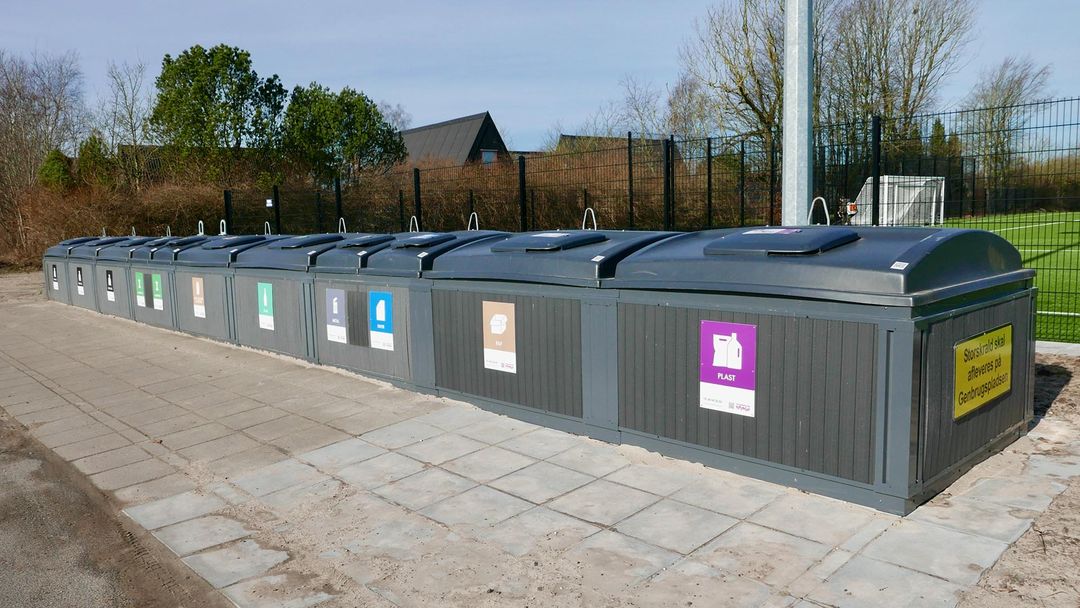
The utility approached it systematically, starting with about ten sensors and scaling to 220 — one for every container. The island now has around 30 collection points covering, among other areas, all holiday homes with 2,300 households. Each point holds six or seven containers and handles ten waste fractions in total. To make collection more efficient, glass and metal are collected as a single fraction.
Alongside the sensors, the utility took the transport and logistics software that retrieves data from every container via the cloud, generates collection routes automatically, and gives drivers the service route and current fill levels through an app.
Fill levels update automatically every six hours. A container is normally added to the service route at 80–90% full. Every Wednesday, an additional check is run for containers that might become critical over the weekend in holiday-home areas — a small local rule that prevents the failure mode most likely to generate complaints.
The results
- The 176 km manual inspection round was eliminated.
- Combined with a move to consolidated collection points, the utility reduced its fleet by one waste collection truck.
- Overflowing containers in the holiday-home areas ceased to be a problem.
- Reliability: one defective sensor out of 220 in the first four months, and no battery replacements across the year.
The operations manager's stated goal, delivered with some satisfaction, is no letters to the editor of the local newspaper about missed collections. It still holds.
It is easy to use and provides an overview, so we are able to delegate the planning of the service route to our driver — he is now fully in charge of the process.Operations manager — Langelands Forsyning
Connectivity on difficult terrain
Langeland is a beautiful island of rolling landscapes, and that initially caused problems transferring data from sensors distributed across it. NB-IoT was the technology that resolved it, providing consistent data transfer about container fill levels. For any UK authority servicing rural bring sites, upland car parks or coastal locations, this is the relevant precedent: NB-IoT reaches places ordinary connectivity does not, because it was designed to.
Expanding is a ten-minute job
The utility runs a subscription covering both the sensors and the software. When a sensor needs installing or replacing, the operations manager frequently does it himself while already out on the road — ten minutes to install a new fill-level sensor and set it up in the software.
That figure matters more than it appears. A deployment where adding a container requires a supplier visit does not grow; one where a supervisor can do it from the cab does. Langeland went from ten sensors to 220 on that basis.
What they were planning next
Two things, both worth noting because they mark the maturity curve of a deployment. Moving to the next generation of radar fill-level sensors for greater precision on cardboard, paper and plastic — the materials that defeat older measurement technology. And beginning to use emptying forecasts rather than reacting to current fill levels alone.
The operations manager recommends other waste handling companies install fill-level sensors, on the grounds that it creates obvious opportunities to optimise operations and that the more rational effort also makes good sense for the employees.
Deployment at a glance
- Operator
- Langelands Forsyning A/S, Langeland, Denmark
- In service since
- 2019
- Sensors
- 220, starting from about 10
- Collection points
- Approximately 30, with 6–7 containers each
- Households covered
- All holiday homes — 2,300 households
- Waste fractions
- 10, with glass and metal combined for efficiency
- Reporting
- Fill levels updated every 6 hours
- Threshold
- Normally added to the route at 80–90% full
- Local rule
- Extra Wednesday check for containers likely to become critical over the weekend
- Replaced
- A 176 km manual inspection round of 50 stations taking 1.5 days
- Fleet
- One collection truck removed from service
- Vehicles
- 1 service truck with trailer handling 4 fractions at a time, plus 3 daily collection trucks
- Reliability
- 1 fault in 220 units over four months; no battery replacements in a year
- Install time
- 10 minutes per sensor, done in-house
- Connectivity
- NB-IoT, adopted to overcome terrain-related data transfer problems
- Commercial model
- Subscription covering sensors and software
These figures are as published by the operating authority. They document a deployment of BrainyBins® by Maacks ApS — the platform Britannia IoT Solutions supplies in the United Kingdom — and are presented as evidence for the technology rather than as a Britannia IoT Solutions client engagement. Outcomes in any given operation depend on current collection frequency, bin density and round geography — which is what a pilot measures.
Questions
Reading the Langeland deployment
How does eliminating an inspection round compare with reducing collections?
In a dispersed rural operation it is frequently the larger saving, and it is often overlooked. Langeland was spending a day and a half and 176 km every cycle simply to find out what was in the containers — before any waste was collected at all. That entire activity disappeared. If your operation currently sends anyone to look at bring sites, that cost should be in the business case alongside the avoided lifts, because it goes to zero rather than merely reducing.
They removed a whole vehicle. Was that the sensors alone?
No, and the case study is clear about it: the reduction came from the sensors combined with a transition to consolidated collection points. That combination is common — better data makes rationalisation possible, and rationalisation is what releases a vehicle. It is worth planning for both together rather than treating sensors as a standalone measure.
One fault in 220 sensors — is that typical?
It is a strong result and it reflects the hardware: a sealed, shock-resistant enclosure with no moving parts and no external connections, in an application with very little to go wrong. The utility also reported no battery replacements across a full year. Sensor health is monitored centrally regardless, so units that stop reporting or run low are flagged before they cause a missed collection rather than discovered afterwards.
What is the Wednesday check about?
A local rule to catch containers likely to become critical over the weekend in holiday-home areas, when nobody is collecting and visitor numbers are highest. It is a good illustration of how these systems are actually configured in practice: the underlying automation is general, and the value comes from the operational knowledge layered on top of it. Rules of that kind are configuration, not custom development.
Next step
See what your own bin data would say
A 90-day pilot on one round tells you exactly how much of your current collection effort is going to bins that were not full. No commitment beyond the pilot, and you keep the data.